‘There is magic underfoot’
How the work is actually made: the rucksack, the gathering, the place palettes and the sketchbooks.
Work is made on the ground. Rucksack essentials consist of a surface to paint on, a couple of brushes, primary colours, a tube of white and a binding medium.
‘Hanging around’ in the landscape with no outcome in mind is an intentional stance. Something always occurs: the light changes, the tide turns, a particular rock formation crops up, an atmosphere shifts. Then, the work begins. Sometimes, rain serves to relax the paint and at others it removes it.
Witness to the permanent impermanence in any moment.
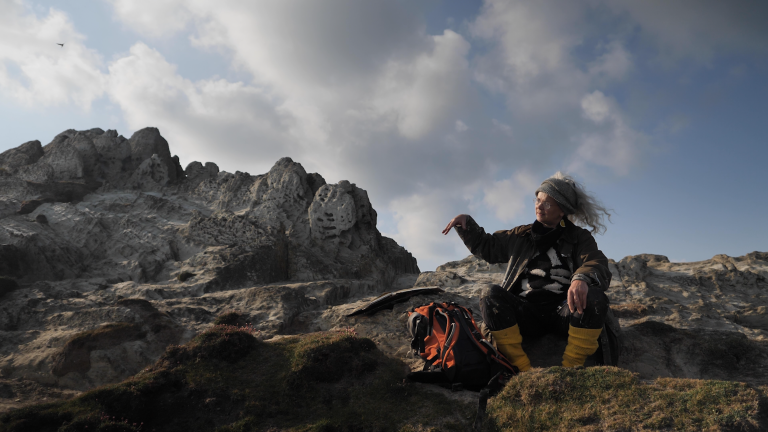
I paint outside, and always have done, since childhood. I come not to observe but seeking to participate in conversation with the commune of place. I respond rather than impose — seeking to express what is without prejudice.
Water-based media (watercolour, acrylic and gouache) sits comfortably within the landscape because water is the vehicle of transport throughout. Water or the absence of it determines the way material moves and comes to rest. Rain, snow, humidity participate. Wind and temperature influence drying times.
When foraging for tools and pigments I’m getting to know a place by sight, touch, smell and sound. This grows my understanding of the material and immaterial nature of where I am.
As I become part of dynamic exchange around me, between and within, linear time relaxes and rounds into cycles.
Gathering
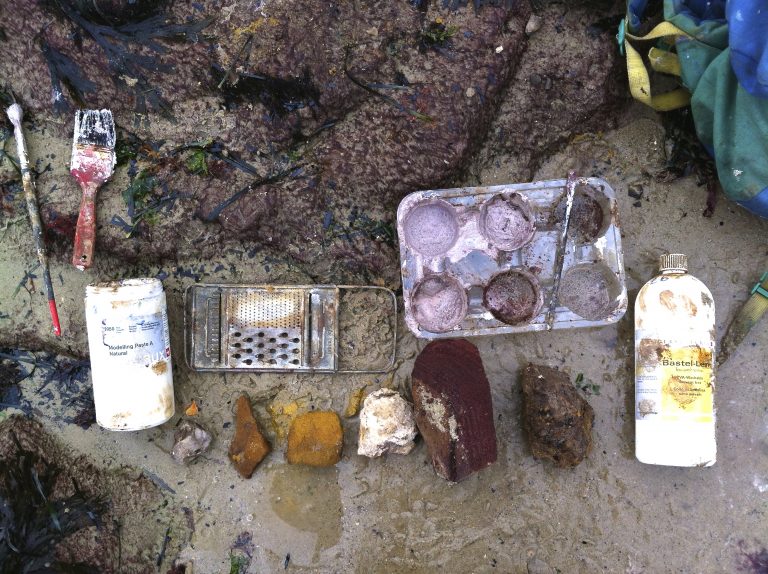
Making palettes
If these palettes could speak, they would say: we were here and this is what we noticed.
Palette-gathering is mysterious, it continues to evolve (over 20 years). It has deepened into a divinatory practice involving an intentional shift in quality of attention. I’ve developed a holding structure to support this.
The ritual is as follows:
- Pause at a threshold (a gate, puddle or stone)
- Enter the location respectfully
- Seek permission to engage with the commune of the Place
- Cultivate porosity
- Allow
- Say thank you before leaving
The process of gathering materials and bringing together what I call ‘place palettes’ is a means of introduction to the commune of place. Curious as I forage, I meet the inhabitants; the earths and ‘stuff’ that are present at that particular time. Each location has a dialect and personality. Each visit to the same area yields a different palette.
Material expressions include both ancient and modern matter: geological samples and litter sit side by side.
Tools and swatches from the site are identified and tested in these palettes. The unconsolidated material requires a binding medium and a vehicle to make a paint or for adhesion. I employ animal protein size, acrylic emulsion, gum arabic or cherry tree gum depending on circumstance.
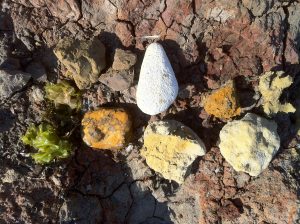
Sketchbooks
A space where anything can land, without judgement. An integral part of the way I ‘sense into place’.
Films
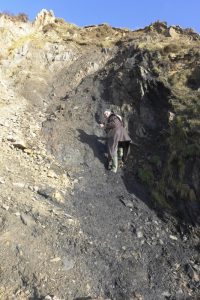
17 filmsInformal films of selected aspects of the practice: the relationship with Place, engaging with the other-than-human inhabitants of these environments, and the materials I bring with me to make work.
- 01 Beginning Making contact with a place: an introduction to my practice. 'Noticings'. 'Place Palettes'. With Professor Simon Olding
- 02 Earth talk Sourcing pigments and listening to the land in preparation for work. Eype, Dorset.
- 03 Drawing with intention Water soluble graphite and pencil. Sandsfoot Castle, Portland Harbour, Dorset.
- 04 Sketchbooks The varying roles they play in relating to place. With Professor Simon Olding
- 05 Lulworth Drawing on site. Concertina sketchbook. Graphite. Scratchy Bottom, Durdle Door, Lulworth, Dorset.
- 06 Yellow talk Which pigment and why. With Evie Hatch, Jackson’s Art
- 07 Blue talk Which pigment and why.
- 08 Red talk — one Establishing a route between orange and violet. With Evie Hatch, Jackson’s Art
- 09 Red talk — two Pooling my stock of reds with those of Evie Hatch we form a seamless red bridge.
- 10 Red talk — three The last of the bridge between orange and violet.
- 11 Poetry and paint The Restless Earth by Jeremy Hooker. The importance of words and kinship with poets Elisabeth Bletsoe and Jeremy Hooker. With Professor Simon Olding
- 12 En plein air 'Warm Willow Squall' in the making. Working on site with 'found' tools. Sandsfoot beach, Portland Harbour, Dorset.
- 13 Lockdown Gift within restriction. I was unable to go out to the landscape and the landscape came to me. Gift Triptych. Outer breakwater to bird bath, Portland Harbour, Dorset. With Professor Simon Olding
- 14 Shine Sharing a particular sunrise experience. Just about to pack up for breakfast. Castle Cove, Portland Harbour, Dorset.
- 15 Moonshine Describing painting moonlight. Castle Cove ledges, Portland Harbour, Dorset.
- 16 Birds for company Drawing in company with birds. Castle Cove, Portland Harbour, Dorset.
- 17 Swifts 2019 in Florence and 2021 over the studio in Weymouth. Travelling to unfamiliar landscape has long been a feature of my work.